
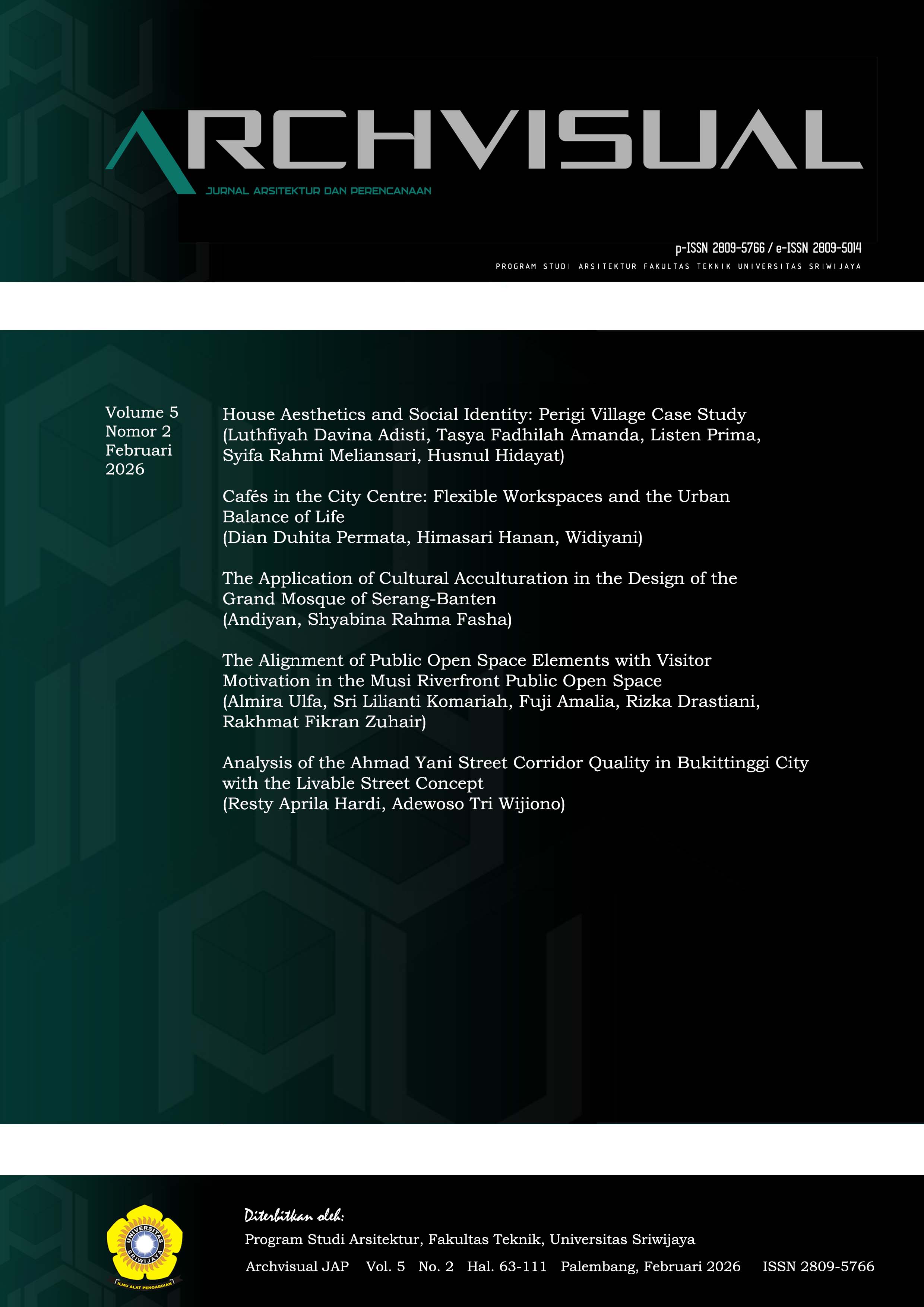
The Alignment of Public Open Space Elements with Visitor Motivation in the Musi Riverfront Public Open Space
Article Sidebar
Main Article Content
Abstract
Public open spaces are considered successful when they are continuously visited and provide tangible benefits to their users. Individuals’ intentions to visit a place, including public open spaces, are driven by internal motivations, whereas the choice of a specific destination is influenced by the elements present within the space. These elements function as pull factors that fulfil visitors’ internal push factors. The Musi River is one of the key images of Palembang City, and several of its riverbanks are utilised as public open spaces consistently visited by the community, including 16 Ilir Market Plaza and Benteng Kuto Besak Plaza. This article examines the elements of public open spaces along the Musi River as pull factors that help fulfil visitors’ push factors in selecting riverfront open spaces as their destination. Data were collected through field observations and the distribution of online questionnaires, and the results were analysed using multivariate correlation analysis. The findings indicate significant relationships between visiting motivations (push factors) and specific elements (pull factors) that are considered essential in public open spaces. In their manifestation as facilities, public open space elements demonstrate a high degree of flexibility, whereby a single element may emerge from the integration of multiple components and derive benefits from the combined elements that constitute it.
Article Details
Section

This work is licensed under a Creative Commons Attribution-NonCommercial 4.0 International License.
How to Cite
References
Bertot, J. C., Mcclure, C. R., & Jaeger, P. T. (2008). The Impacts of Free Public Internet Access on Public Library Patrons and Communities. Library Quarterly, 78(3), 285–301. http://www.ii.fsu.edu/plinternet. DOI: https://doi.org/10.1086/588445
Beute, F., Marselle, M. R., Olszewska-Guizzo, A., Andreucci, M. B., Lammel, A., Davies, Z. G., Glanville, J., Keune, H., O’Brien, L., Remmen, R., Russo, A., & de Vries, S. (2023). How do different types and characteristics of green space impact mental health? A scoping review. In People and Nature (Vol. 5, Issue 6, pp. 1839–1876). John Wiley and Sons Inc. https://doi.org/10.1002/pan3.10529 DOI: https://doi.org/10.1002/pan3.10529
Cahyaningtyas, M. A., & Kusuma, H. E. (2020). Preferensi Masyarakat terhadap Ruang Kota sebagai Tempat Relaksasi. Jurnal RUAS, 18(1). DOI: https://doi.org/10.21776/ub.ruas.2020.018.01.1
Cao, J., & Kang, J. (2019). Social relationships and patterns of use in urban public spaces in China and the United Kingdom. Cities, 93, 188–196. https://doi.org/10.1016/j.cities.2019.05.003 DOI: https://doi.org/10.1016/j.cities.2019.05.003
Do, D. T., Cheng, Y., Shojai, A., & Chen, Y. (2019). Public Park behaviour in Da Nang: An investigation into how open space is used. Frontiers of Architectural Research, 8(4), 454–470. https://doi.org/10.1016/j.foar.2019.05.006 DOI: https://doi.org/10.1016/j.foar.2019.05.006
Durán Vian, F., Pons Izquierdo, J. J., & Serrano Martínez, M. (2021). River-city recreational interaction: A classification of urban riverfront parks and walks. Urban Forestry and Urban Greening, 59. https://doi.org/10.1016/j.ufug.2021.127042 DOI: https://doi.org/10.1016/j.ufug.2021.127042
Ekawati, S. A., Ali, M., Trisutomo, S., & Ghani, R. C. A. (2020). The Study of Public Open Space effectiveness in Makassar Waterfront City using Good Public Space Index (GPSI). IOP Conference Series: Materials Science and Engineering, 875(1). https://doi.org/10.1088/1757-899X/875/1/012003 DOI: https://doi.org/10.1088/1757-899X/875/1/012003
El-Cheikh, S. (2018). The Participatory Approach for Waterfront Development in Mediterranean Countries. A Case Study of Tripoli, Lebanon Waterfront. Architecture and Planning Journal (APJ), 24. DOI: https://doi.org/10.54729/2789-8547.1025
Gascon, M., Mas, M. T., Martínez, D., Dadvand, P., Forns, J., Plasència, A., & Nieuwenhuijsen, M. J. (2015). Mental health benefits of long-term exposure to residential green and blue spaces: A systematic review. In International Journal of Environmental Research and Public Health (Vol. 12, Issue 4, pp. 4354–4379). MDPI. https://doi.org/10.3390/ijerph120404354 DOI: https://doi.org/10.3390/ijerph120404354
Geary, R. S., Thompson, D. A., Garrett, J. K., Mizen, A., Rowney, F. M., Song, J., White, M. P., Lovell, R., Watkins, A., Lyons, R. A., Williams, S., Stratton, G., Akbari, A., Parker, S. C., Nieuwenhuijsen, M. J., White, J., Wheeler, B. W., Fry, R., Tsimpida, D., & Rodgers, S. E. (2023). Green–blue space exposure changes and impact on individual-level well-being and mental health: a population-wide dynamic longitudinal panel study with linked survey data. Public Health Research, 1–176. https://doi.org/10.3310/lqpt9410 DOI: https://doi.org/10.3310/LQPT9410
Gusti, I., Febrianto, A., Fitri Anggani, M., & Utama, I. P. (2025). Push dan Pull Factor Motivasi Wisatawan Berkunjung ke Desa Wisata Lebakmuncang. R2J, 7(4). https://doi.org/10.38035/rrj.v7i4 DOI: https://doi.org/10.38035/rrj.v7i4.1499
Hampton, K. N., Livio, O., Trachtenberg, C., & Mcewen, R. (2010). The Social Life of Wireless Urban Spaces. Contexts, 9(4). DOI: https://doi.org/10.1525/ctx.2010.9.4.52
Hatem, N., Elshater, A., Afifi, S., & Alfiky, A. (2024). Impact of wireless networking technology on social interaction in Cairo’s public spaces. Ain Shams Engineering Journal, 15(12). https://doi.org/10.1016/j.asej.2024.103114 DOI: https://doi.org/10.1016/j.asej.2024.103114
Jaya, A. P., Lussetyowati, T., & Hidayat, H. (2022). Kearifan Lokal dalam Arsitektur Rumah Rakit Palembang. Jurnal Arsitektur Zonasi, 5. https://doi.org/10.17509/jaz.v5i2.34897
Mehta, V. (2014). Evaluating Public Space. Journal of Urban Design, 19(1), 53–88. https://doi.org/10.1080/13574809.2013.854698 DOI: https://doi.org/10.1080/13574809.2013.854698
Olafsdottir, G., Cloke, P., Schulz, A., van Dyck, Z., Eysteinsson, T., Thorleifsdottir, B., & Vögele, C. (2020). Health Benefits of Walking in Nature: A Randomized Controlled Study Under Conditions of Real-Life Stress. Environment and Behavior, 52(3), 248–274. https://doi.org/10.1177/0013916518800798 DOI: https://doi.org/10.1177/0013916518800798
Shangi, Z. A. D., Hasan, M. T., & Md, I. A. (2020). Rethinking Urban Waterfront as a Potential Public Open Space: Interpretative Framework of Surma Waterfront. Architecture Research, 2020(3), 69–74. https://doi.org/10.5923/j.arch.20201003.01
Shao, Z., Tang, Y., & Zhang, J. (2025). Users’ Perceptions of Public Space Quality in Urban Waterfront Regeneration: A Case Study of the South Bank of the Qiantang River in Hangzhou, China. https://doi.org/10.20944/preprints202512.1140.v1 DOI: https://doi.org/10.20944/preprints202512.1140.v1
Smith, N., Georgiou, M., King, A. C., Tieges, Z., Webb, S., & Chastin, S. (2021). Urban blue spaces and human health: A systematic review and meta-analysis of quantitative studies. Cities, 119. https://doi.org/10.1016/j.cities.2021.103413 DOI: https://doi.org/10.1016/j.cities.2021.103413
Tamba, H., & Nuraini, C. (2025). Analysis of Collective Memory of Waterfront City Transformation in Pangururan, Samosir Regency. 2nd International Conference on Islamic Community Studies (ICICS).
Üzümcüoğlu, D., & Polay, M. (2022). Urban Waterfront Development, through the Lens of the Kyrenia Waterfront Case Study. Sustainability (Switzerland), 14(15). https://doi.org/10.3390/su14159469 DOI: https://doi.org/10.3390/su14159469
Wang, W., Liu, A., & Xu, X. (2025). The Spatio-Temporal Evolution and Sustainable Development Strategy of Huizhou’s Traditional Villages in the Xin’an River Basin. Land, 14(1). https://doi.org/10.3390/land14010102 DOI: https://doi.org/10.3390/land14010102
Whyte, H. (2001). The social life of the small urban space. Project for Public Spaces.
Wright, K., Eden, S., Hancox, A., Windget, D., Elliott, L., Glossop, Z., Johnston, G., Johnston, R. I., Lobban, F., Lodge, C., Palmier-Claus, J., Parkin, S., White, P. C. L., & Bell, S. L. (2024). A qualitative exploration of the contribution of blue space to well-being in the lives of people with severe mental illness. People and Nature, 6(2), 849–864. https://doi.org/10.1002/pan3.10620 DOI: https://doi.org/10.1002/pan3.10620
Xian, Z., Nakaya, T., Liu, K., Zhao, B., Zhang, J., Zhang, J., Lin, Y., & Zhang, J. (2024). The effects of neighbourhood green spaces on mental health of disadvantaged groups: a systematic review. In Humanities and Social Sciences Communications (Vol. 11, Issue 1). Springer Nature. https://doi.org/10.1057/s41599-024-02970-1 DOI: https://doi.org/10.1057/s41599-024-02970-1
Xie, P. F., & Gu, K. (2015). The changing urban morphology: Waterfront redevelopment and event tourism in New Zealand. Tourism Management Perspectives, 15, 105–114. https://doi.org/10.1016/j.tmp.2015.05.001 DOI: https://doi.org/10.1016/j.tmp.2015.05.001